The Solar System doesn't end where the solar wind stops
Far beyond the heliosphere is a vast spherical cloud of PERHAPS A TRILLION ICY OBJECTS.
It's called the Oort Cloud and it surrounds us in all directions.
How far is far?
The tiny yellow speck at the top of the vertical line below represents the Sun and all its planets, 0 to 30 AU.
The Heliosphere, the Sun's solar-wind bubble, fades out around 120 AU.
On the scale of the Oort Cloud, that barely registers. Keep that in mind as you scroll.
The Sun's faintest grip
At the far edge of the Oort Cloud, around 100,000 AU out, the Sun's gravity is about times weaker than at its surface!
That sounds like nothing... and it almost is.
But the Oort Cloud sits in such vast emptiness that even this faint pull can matter. The Sun does not grip these comets tightly; it keeps them loosely associated with the Solar System.
The Oort Cloud is not a neat shell of comets locked in place. Its objects move on vast, fragile orbits that and the wider pull of the
The Sun itself is orbiting something.
At the centre of the Milky Way sits Sagittarius A*, a supermassive black hole, and the Sun traces a slow orbit around it, one lap every 225 million years. We call that a galactic year.
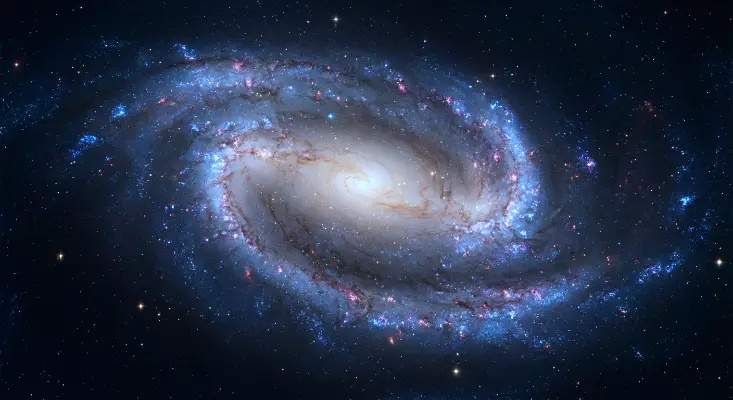
Take the huge line you just scrolled through. Now shrink it to the size of this tiny dot → ·
At this new scale, you'd need to scroll 36.5 more screen-heights to reach the centre of the Milky Way. The entire Solar System, everything you've explored here, would be invisible.
You've reached the far edge of this journey.