Neptune feels like the edge.
It isn't.
Beyond it, the Solar System stops looking like a neat row of planets and opens into a sparse outer wilderness of icy worlds, stretched orbits, and the vast bubble of the Sun itself.
Schematic diagram from 0 to 120 astronomical units. The planet zone runs from the Sun through Neptune in the first 30 AU. The Kuiper Belt spans roughly 30 to 50 AU. The scattered disk extends on longer paths toward 100 AU and beyond. The heliosphere bubble reaches about 120 AU.
1 AU = The average distance from Earth to the Sun.
The planets mostly orbit in a flat plane
The planets mostly orbit in the same flat plane, not perfectly, but far more neatly than the distant worlds beyond Neptune.
Beyond Neptune, the orbits get weird
Beyond Neptune, the Solar System becomes less tidy. The Kuiper Belt begins as a broad donut-shaped zone of icy bodies. Beyond it, scattered objects follow longer, rougher, more tilted paths. The scattered disk is largely Neptune's handiwork.
Select an orbit to explore a few example worlds beyond Neptune.
The heliosphere: Solar winds
The Sun does not only hold the Solar System with gravity. It also blows a stream of charged particles outward: solar wind.
That wind inflates a vast bubble around the Solar System called the heliosphere. Its outer edge, the heliopause, lies roughly 120 AU from the Sun - far beyond Neptune, the Kuiper Belt, and the scattered disk.
Inside the heliosphere, the solar wind fills space. Far out, it weakens until it gives way to interstellar space.
Auroras: the solar wind reaching Earth
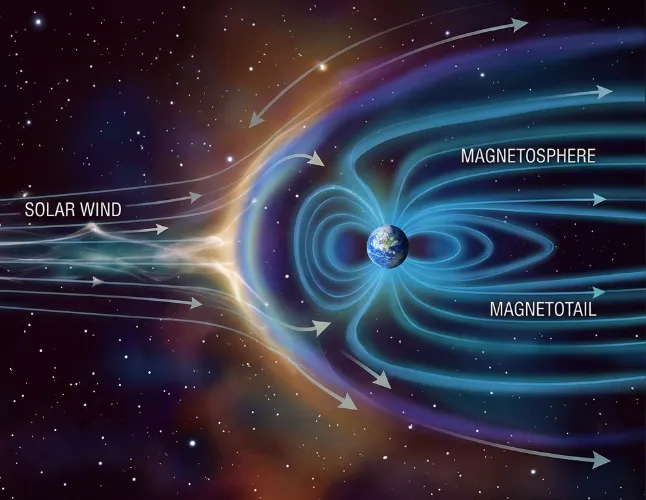
Earth sits inside that giant bubble, but it also has a smaller shield of its own: the magnetosphere.
Several other planets have magnetospheres too. Earth's magnetic field deflects much of the solar wind, but some particles are channelled toward the poles.
There, they collide with the upper atmosphere and make it glow as auroras.